
Discover Cromford – A walk around Scarthin and Chapel Hill
Walk 2 – A Walk around Scarthin and Chapel Hill
This will take about 45 minutes
From the Market Place, turn up Scarthin following the sign to the Post Office. This was a lead mining settlement, with rows of small cottages built in tiers on the hillside and following the course of the old road through Upperwood to Matlock. Most were demolished after the war. In 1815 a huge outcrop of rock was blasted away to deepen Scarthin Nick and to make a way through for the newly laid turnpike road which was later to become the A6. On the left is the Boat Inn, originally known as “a Beer-house” and more recently called “Hit and Miss”, with the date 1772 above the door. Walk across the open area just beyond the inn and look over the railings. Here the water pours out of the pond and runs by the side of the Greyhound Hotel before disappearing under the Market Place. In 1908 Matlock Bath and Scarthin Nick Urban District Council bought land from Frederick Charles Arkwright and began construction of the Promenade in place of the gardens beside the pond. The railings came second hand from Matlock Bath where they had been replaced by higher railings.
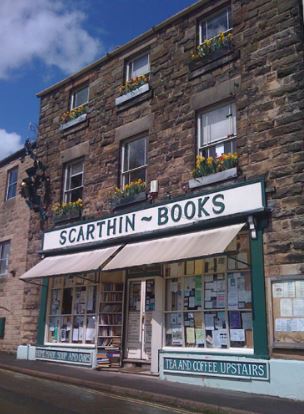
Continue to walk up the Promenade. “The Dom”, also known as the Greyhound Pond, is a man-made dam and reservoir, built to store water for Sir Richard Arkwright’s mills. It was created around 1785 and was fed by water from the Bonsall Brook and Cromford Sough. On the right is the Old Printing Works (now a house) built in 1826. The Chapel, now a light engineering works, was the Mount Tabor Chapel, built in 1862 and extended in 1907 and nextdoor is the popular bookshop Scarthin Books, formerly Scarthin House. On the Promenade is the Scarthin War Memorial, with the names of the 12 men from Scarthin who died in the two world wars.
Continuing past the Pond, note the Primitive Methodist Chapel on the left, dated 1854. It is now a private house. Opposite is the signposted start of footpaths to Matlock Bath and Bonsall. At the bottom of Scarthin on the right is another old chapel, in use as a garage. This was the Scarthin Mission Room, built by the vicar and churchwardens of Holy Trinity church at Matlock Bath, when Scarthin was part of that parish in 1869. It became redundant in the 1950s.
For many years Scarthin was part of Matlock Bath. The ancient parish boundary ran along the edge of the pond. In 1892 Scarthin consisted of the row on the waterfront and extended up the hillside; the three or four rows of houses were densely populated. In 1890 there were 121 houses in Scarthin, with a population of 600! In the 1950’s and 60’s many of the houses seen on the old photograph of the Greyhound Pond were declared unfit for habitation and the inhabitants moved to new housing across the valley or in Matlock.
Scarthin leads to Water Lane. Keep to the same side of the road, and walk beyond the garage and alongside a row of houses. This is Staffordshire Row, reputed to have been built for workers brought in from Staffordshire to work in the old smelting mill in the 1720s. However, this terrace stands on land awarded to Richard Arkwright in the Matlock Enclosure in 1784 and are very similar to the terraces on Cromford Hill. It is probable that they were built by Arkwright as part of his factory village.
You will now come to the start of Chapel Hill. This road was earlier called Stoney Way road and was the original route from Cromford to Bonsall. It took its new name from the Wesleyan Methodist Chapel, 1810, a prominent four-storey building near the foot of the hill, with a school room underneath. This was converted into two houses by J.Willn, involving the demolition of the front two storeys above the schoolroom, now disused, and above it and set back is a blue gabled house which bears the inscription JW 1906.
Further up is Via Gellia House, built by Nathaniel Wheatcroft around 1780. The Wheatcroft family operated the canal boats from Cromford Wharf, where their name can still be seen. The adjoining row of three storey houses was also developed by Wheatcroft, number 26 has the original cast iron window frames in the top storey. The road peters out into a footpath leading to Bonsall, now via a diversion around Ball Eye Quarry.
Retrace your steps to Water Lane and cross over. Go through the gap in the to the right of the former maltings, to the dam of the Corn Mill Pond. This collects water from Bonsall Brook. Continue over the little bridge which spans the sluice where water surges down from the dam before disappearing into a culvert. The water is piped under the road and re-emerges in a pipe on the far side of Water Lane to turn the water wheel at the old paint mill, previously a calamine mill.
Continue along the side of the corn mill where you can see evidence of the positions of two waterwheels. The corn mill with attached cottage was built by Arkwright circa 1780 to serve the village, and closed in 1935. It is on the site of a previous mill worked by a company from Cheadle in Staffordshire for the smelting of zinc oxides. It was this company which may have built Staffordshire Row for its workers. Look back at the houses on Chapel Hill, with their ornate chimney pots, set against the backdrop of a wooded hillside.
Carry on to the right by the artificial grass sports area and climb the steep steps set into the hillside. These lead to a footpath known as “The Goat” (from “Goyt”) through Slinter Wood. Turn left; the path comes out into a field. Go left again to return to Water Lane. Now go right to skirt the pond. Cross over to look at the waterwheel. Here the locally mined barytes was ground to make powder used in the manufacture of paint. The overshot waterwheel dates from the middle of the 19th century and is supplied by water from the corn mill dam before being discharged into Cromford Pond. The mill buildings are now occupied by Home Products. Cross back over the road, and continue past the basket works car park. The Methodist Church was built in 1900 and until 2024 was the only chapel still in use as a place of worship. At the time of writing, this building has sadly been sold for development. The road emerges on to Cromford Hill. Turn left to return to the Market Place. Note the old coach house and stable buildings in the Greyhound Yard, which have recently been converted into apartments, and the former Bank built on to the side of the hotel.


