Cromford Heritage Walks
Discover Cromford – Cromford Village Heritage Walks
There are five walks detailed below of different lengths.
Walk One – A Walk around the Village
This walk will take up to an hour. Allow extra time if you take option 3.
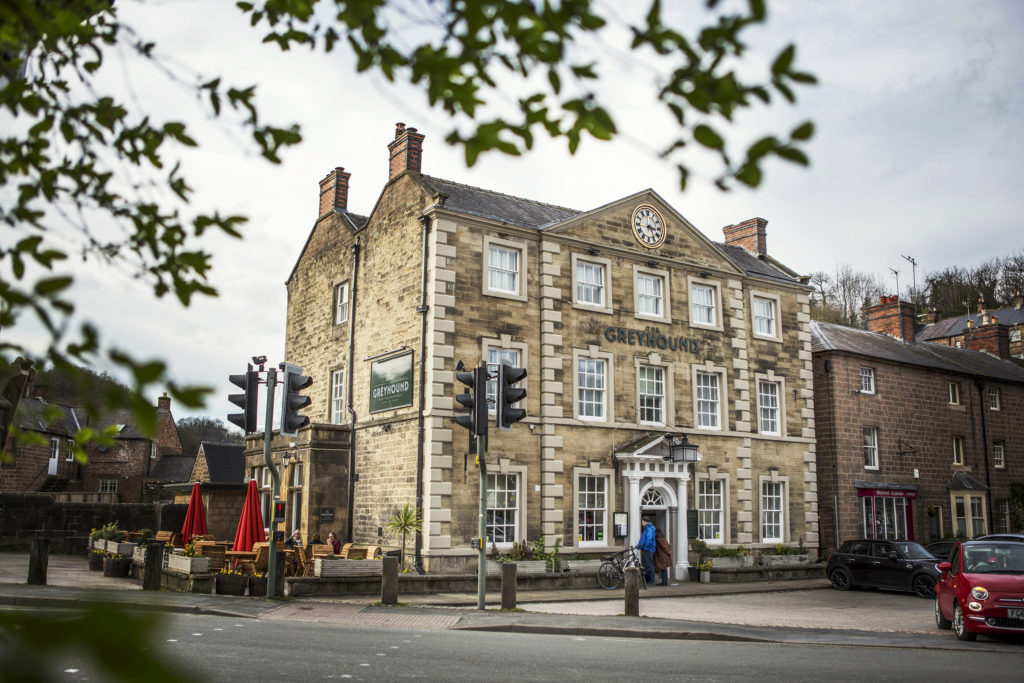
Turn left to the Market Place. To your right you will see the Greyhound Hotel. This imposing inn was built in 1778 by Arkwright for businessmen and his many visitors. It incorporated a bank; its windows and door can be seen on the left side of the building. The original clock is still there. In 1790 Arkwright obtained a charter for a Saturday market (closed 1880). The houses next to the Greyhound were originally shops, and the row of single story shops on the right were market stalls, known as the Shambles. Before the advent of the railways, this would have been a hive of activity. Coaches, such as the Defiance and the Lord Nelson set off daily to London, Birmingham, Sheffield, Nottingham and Manchester. Carriers operated services several days a week to London and various towns in Derbyshire.
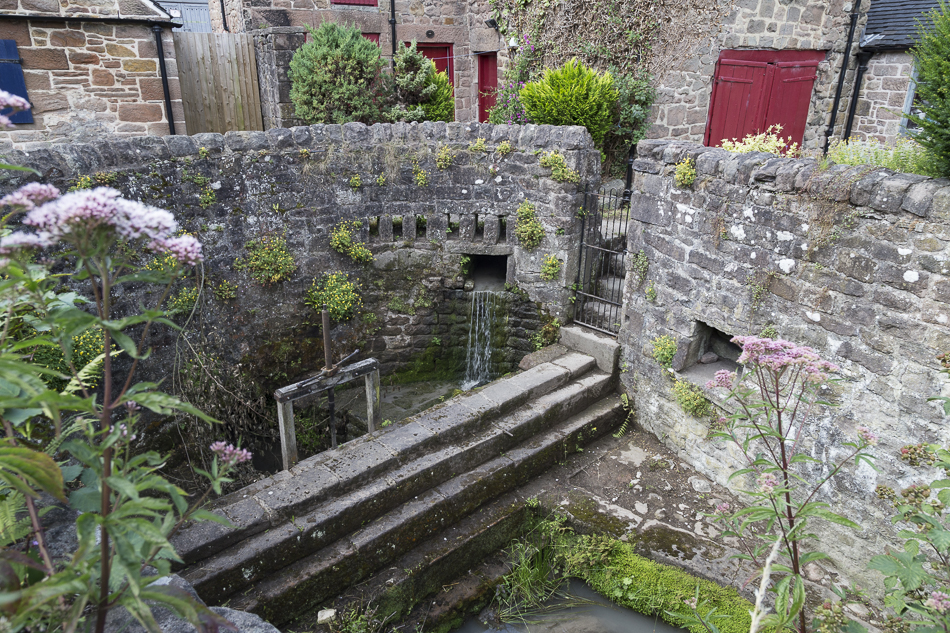
Cross the road, walk right past the Arkwright Stores, one of a row of six houses, built by Richard Arkwright as part of his factory village in the 1780s and converted for retail use in the 19th century. The two bowed shop windows are a rare survival from the early 19th century. Originally it had a slate roof. Take the entry to the left. A short way along the path can be seen the walled culvert constructed by Richard Arkwright in 1785 to control the flow of the Cromford Sough to the cotton mills by means of gates and wooden stop boards. This stone pit was sunk into the Sough, which drained water from the lead mines. It is comprised of a dam which held the water and forced it into an underground channel to the millpond behind the Greyhound and a sluice, which controlled water to be supplied directly to the Mill. It could also act as a drain from the pond. Water was redirected to the pond on Sundays in order to top it up in readiness for the new week ahead at Arkwright’s mill, which now had a second wheel. This surprising structure is known as the Bear Pit – bear baiting was all the rage in the 16th and 17th centuries and was not banned until 1835.
Beyond the Bear Pit are the remains of stone pig sties and troughs. Opposite is a yard where a square of cobbles can be seen. Here animals were slaughtered. The old village lock-up, which has two small cells where offenders were held, is at the opposite corner of the yard. It is the middle part of a building which predates the Arkwright period, and was originally three cottages. The middle cottage became the lock-up after 1790, when the Quarter Sessions, or local courts, required that each community should provide a secure place for alleged felons to be held until they could be transferred to Derby. This contains two small cells with metal doors. One cell retains its original bunk, which is suspended from the walls by a chain. Arkwright imprisoned anyone thieving from his Mill.
Return to the path and continue between allotments and more pig sties. On the right is the old pinfold, used as a holding field for cattle awaiting slaughter. The backs of the houses on North Street can be seen, note the blocked up windows of the top storeys which were used by framework knitters and weavers. The path comes out opposite the rear of the school. Built in 1832, together with a schoolmaster’s house, by Richard Arkwright junior, it had provision for 200 boys and girls who were housed in separate buildings along the sides of a square court. Later enlarged and altered, it is now a Church of England primary school with about 180 pupils.
Turn right, and you enter the bottom end of North Street. These houses were built between 1776-7 by Arkwright to house his mill workers. It is the first planned industrial housing in Derbyshire with two rows of gritstone 3-storied houses, each originally consisting of a living room, bedroom and interconnecting weaving rooms in the attic. Bathrooms and kitchens were added later at the rear. The attic rooms had windows at the back and front to give good light for the outworkers at their frames. The windows at the back of the houses have since been blocked off. Number 10 belongs to the Landmark Trust which has restored the house inside and the rear attic window.
The railings at the front of the school were replaced in 2002 after being removed in WW2 to help the war effort. You will see a trough to the right of the school railings. This was the original water supply for the entire street, being fed by Longhead sough. Follow the path winding between the back of the North Street houses and the raised gardens. Down here you will see a barn, pre-dating Arkwright, inside were the old cattle stalls. The building has been converted into a house. The path emerges on Cromford Hill. Turn left and a short way on turn left again into Bedehouse Lane. The path veers to the right and then goes straight uphill, following the backs of houses. Views open out on the left across the fields to Ferny Rocks. Look back to see the Arkwright family’s mansion, Willersley Castle in the distance.
Continue uphill to the Almshouses. These were founded in 1662 in accordance with the will of Mary Talbot, the Lady Armine, who left money and land for bede houses for six poor and elderly widows and widowers. A weathered stone coat-of-arms can be seen on the side of the building, which is still in occupation. The path passes some pretty stone cottages, before emerging onto Barnwell Lane.
There are 3 options here:
Option 1. On Barnwell Lane turn right. The road comes out on Cromford Hill. The house on the left at the junction, by the bus stop was once the Red Lion Public House. Carefully cross the busy road and follow the pavements back down to the Market Place. There are Arkwright houses lining the opposite side of the road, these are later than those in North Street. Further down adjoining Alabaster Lane are several pre-Arkwright late 17th and early 18th century houses. Below North Street, several houses of Victoria Terrace (built 1839) have the traditional wet wash finish and some the original window frames.
Option 2. Cross Barnwell Lane and follow the steep signposted path. Look to the right to see the large working Dene Quarry. The path emerges onto Baker’s Lane. Turn right here and as you walk look at the views over Cromford. The tall red chimney of Masson Mill, Willersley Castle and Ball Eye Quarry can all be seen in the distance, with Riber Castle on the skyline. To the left are the Black Rocks. You come out onto Cromford Hill. Turn right to return to the Market Place as in option 1.
Option 3. On Barnwell Lane turn left. This is a rather longer walk back to the village over fields. Round the corner and up a bit there is a track on the left which leads past a farmhouse. No longer a working farm, the barns and cattle sheds are now mostly converted. Continue past Spring Cottage and through a stile into a field. There are good views of Scarthin to the left. You now go through another stile into a second field, passing a tumbledown stone barn. Views of the village open out and you can see Dene Quarry and Chapel Hill. To the right the ground rises steeply to a rock outcrop called Ferny Rocks. If you climb up the field and keep to the right of Ferny Rocks you will find a path which lead through woodland to Intake Lane and so back to Cromford, or go higher to join the High Peak Trail. Continue into the next field. To the left can be seen Alison House, Willersley Castle and Rock House. You now enter the last field. The views to the left include Ball Eye Quarry, Cromford Court and the Heights of Abraham and Solomon’s Temple in Matlock Bath. The track emerges via a stile onto Intake Lane. To the right the road leads to the High Peak Trail and Cromford Canal or Black Rocks. Turn left downhill. The houses here were built mainly in the 1950s and 1960s to meet a demand for housing in the area when Derbyshire County Council headquarters moved from Derby to Matlock. There are some old houses on Intake Lane itself, namely Ashes Farm and a cluster of cottages. On reaching Derby Road (A6) turn left for a short walk back to the Market Place.
Walk 2 – A Walk around Scarthin and Chapel Hill
This will take about 45 minutes
From the Market Place, turn up Scarthin following the sign to the Post Office. This was a lead mining settlement, with rows of small cottages built in tiers on the hillside and following the course of the old road through Upperwood to Matlock. Most were demolished after the war. In 1815 a huge outcrop of rock was blasted away to deepen Scarthin Nick and to make a way through for the newly laid turnpike road which was later to become the A6. On the left is the Boat Inn, originally known as “a Beer-house” and more recently called “Hit and Miss”, with the date 1772 above the door. Walk across the open area just beyond the inn and look over the railings. Here the water pours out of the pond and runs by the side of the Greyhound Hotel before disappearing under the Market Place. In 1908 Matlock Bath and Scarthin Nick Urban District Council bought land from Frederick Charles Arkwright and began construction of the Promenade in place of the gardens beside the pond. The railings came second hand from Matlock Bath where they had been replaced by higher railings.
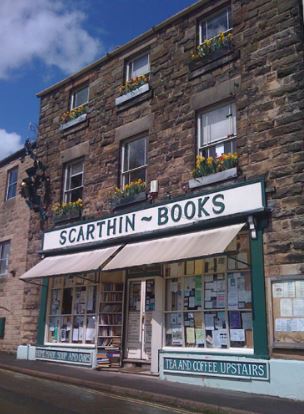
Continue to walk up the Promenade. “The Dom”, also known as the Greyhound Pond, is a man-made dam and reservoir, built to store water for Sir Richard Arkwright’s mills. It was created around 1785 and was fed by water from the Bonsall Brook and Cromford Sough. On the right is the Old Printing Works (now a house) built in 1826. The Chapel, now a light engineering works, was the Mount Tabor Chapel, built in 1862 and extended in 1907 and nextdoor is the popular bookshop Scarthin Books, formerly Scarthin House. On the Promenade is the Scarthin War Memorial, with the names of the 12 men from Scarthin who died in the two world wars.
Continuing past the Pond, note the Primitive Methodist Chapel on the left, dated 1854. It is now a private house. Opposite is the signposted start of footpaths to Matlock Bath and Bonsall. At the bottom of Scarthin on the right is another old chapel, in use as a garage. This was the Scarthin Mission Room, built by the vicar and churchwardens of Holy Trinity church at Matlock Bath, when Scarthin was part of that parish in 1869. It became redundant in the 1950s.
For many years Scarthin was part of Matlock Bath. The ancient parish boundary ran along the edge of the pond. In 1892 Scarthin consisted of the row on the waterfront and extended up the hillside; the three or four rows of houses were densely populated. In 1890 there were 121 houses in Scarthin, with a population of 600! In the 1950’s and 60’s many of the houses seen on the old photograph of the Greyhound Pond were declared unfit for habitation and the inhabitants moved to new housing across the valley or in Matlock.
Scarthin leads to Water Lane. Keep to the same side of the road, and walk beyond the garage and alongside a row of houses. This is Staffordshire Row, reputed to have been built for workers brought in from Staffordshire to work in the old smelting mill in the 1720s. However, this terrace stands on land awarded to Richard Arkwright in the Matlock Enclosure in 1784 and are very similar to the terraces on Cromford Hill. It is probable that they were built by Arkwright as part of his factory village.
You will now come to the start of Chapel Hill. This road was earlier called Stoney Way road and was the original route from Cromford to Bonsall. It took its new name from the Wesleyan Methodist Chapel, 1810, a prominent four-storey building near the foot of the hill, with a school room underneath. This was converted into two houses by J.Willn, involving the demolition of the front two storeys above the schoolroom, now disused, and above it and set back is a blue gabled house which bears the inscription JW 1906.
Further up is Via Gellia House, built by Nathaniel Wheatcroft around 1780. The Wheatcroft family operated the canal boats from Cromford Wharf, where their name can still be seen. The adjoining row of three storey houses was also developed by Wheatcroft, number 26 has the original cast iron window frames in the top storey. The road peters out into a footpath leading to Bonsall, now via a diversion around Ball Eye Quarry.
Retrace your steps to Water Lane and cross over. Go through the gap in the to the right of the former maltings, to the dam of the Corn Mill Pond. This collects water from Bonsall Brook. Continue over the little bridge which spans the sluice where water surges down from the dam before disappearing into a culvert. The water is piped under the road and re-emerges in a pipe on the far side of Water Lane to turn the water wheel at the old paint mill, previously a calamine mill.
Continue along the side of the corn mill where you can see evidence of the positions of two waterwheels. The corn mill with attached cottage was built by Arkwright circa 1780 to serve the village, and closed in 1935. It is on the site of a previous mill worked by a company from Cheadle in Staffordshire for the smelting of zinc oxides. It was this company which may have built Staffordshire Row for its workers. Look back at the houses on Chapel Hill, with their ornate chimney pots, set against the backdrop of a wooded hillside.
Carry on to the right by the artificial grass sports area and climb the steep steps set into the hillside. These lead to a footpath known as “The Goat” (from “Goyt”) through Slinter Wood. Turn left; the path comes out into a field. Go left again to return to Water Lane. Now go right to skirt the pond. Cross over to look at the waterwheel. Here the locally mined barytes was ground to make powder used in the manufacture of paint. The overshot waterwheel dates from the middle of the 19th century and is supplied by water from the corn mill dam before being discharged into Cromford Pond. The mill buildings are now occupied by Home Products. Cross back over the road, and continue past the basket works car park. The Methodist Church was built in 1900 and until 2024 was the only chapel still in use as a place of worship. At the time of writing, this building has sadly been sold for development. The road emerges on to Cromford Hill. Turn left to return to the Market Place. Note the old coach house and stable buildings in the Greyhound Yard, which have recently been converted into apartments, and the former Bank built on to the side of the hotel.
Walk 3 – A walk to Willersley Castle & the Railway Station
This walk will take about an hour and a half.
From the Market Place, walk left and cross the A6 at the traffic lights. Walk past the octagonal wooden building, now The Tors cafe and mentioned by the author Alison Uttley as a barber’s shop where she had her hair cut as a girl. Go past the bus stop and then turn left onto Church Walk. To the left, across the river you can see Willersley Castle. Sir Richard Arkwright began building here on a site cut from solid rock. He commissioned a London architect to build a mansion befitting his wealth and importance. The house was badly damaged by fire, and Sir Richard died a year later in 1792, never having lived there. The house was completed by his son Richard. Pevsner described it as “classical in conception, but romanticised by battlements.” During the Great War the castle was used as an auxiliary hospital, while in the Second World War the Salvation Army’s Mothers’ Hospital in Clapton, London, was evacuated here. Between 1940 and 1946 over 4000 babies were born at Willersley!
Ahead is St Mary’s Church, built by Richard Arkwright as a private chapel It was finally completed in 1797, five years after his death, and opened for public worship by his son, Richard Arkwright Junior. Originally a plain Georgian building, it was much altered in 1858 by Peter Arkwright. The west front was added and the tower enlarged. Later a handsome clock face was erected, dated AD 1869, but the mechanism dates from 1796. Inside there is an organ gallery. Wall paintings and stained glass windows were added to celebrate the first centenary. Plaques and monuments commemorate the Arkwright family. Sir Richard was buried here after being first interred at Matlock. Other members of the family are buried in the small graveyard by the river, including Frederic who was killed in the First World War.
Walk to the end, past the church and turn left. Go past the entrance to Cromford Meadows towards Cromford Bridge. On the right is a small building erected in the 1790s in the style of a Fishing Lodge, and inscribed “Piscatoribus sacrum”. It was originally occupied by the water bailiff for the Arkwright estate, and was lived in until 1914. Between this building and the river bank are the remains of an early 15th century Bridge Chapel. Little is left of the chapel beyond part of the north and south walls, and the footings of the chancel to the east. There is an arched doorway and a window in the south wall, while the north wall contains a look-out or squint hole through which the river can be seen. At one stage in its history the chapel was used as a cottage, pulled down by Arkwright 2 in 1796 when the new church was built. On the bridge is an inscription carved into the stone – “THE LEAP OF MR B.H.MARE JUNE 1697”. Its meaning had been forgotten and various theories put forward, until in 1933 Mr Henry Douglas wrote in “The Derbyshire Countryside” that according to a family tradition it related to Benjamin Hayward of Bridge House, whose horse failed to take the bend and leapt over the parapet into the river below. Both survived. Benjamin Hayward was married to Elizabeth Wigley, who was from an old Cromford family.
Cromford Bridge at that time would have been only 12 feet wide. It was built in the 15th century at the site of a ford, with three pointed arches, and refuges over the bridge supports. Excavations at the chapel in the 1950s revealed traces of a stone abutment to an earlier timber bridge. About 200 years ago it was widened on the north side, where the arches are rounded. Having crossed the bridge, turn right to visit the Railway Station. The steep road climbing to Starkholmes was the route north before a way was blasted through Scarthin Tor. Continue on the road by the river, passing Cromford Bridge House, now re-named Cromford Bridge Hall. It was built by the Wigley family of Wirksworth in the 17th century. In the attics there is evidence of an earlier timber framed house.
Cromford Railway Station is up a left turn before the railway bridge. This stretch of railway from Ambergate to Rowsley was engineered by George Stephenson, and opened in June 1849. It was extended to Manchester eighteen years later. In the original plans the station was to be sited at the south end of Cromford Meadows, where the line veered away from the river, with plans for a new canal wharf. Negotiations took place with Peter Arkwright, grandson of Sir Richard, who wanted sidings built to the existing wharf. Failure to agree led to the opening of a temporary station in the cutting at the mouth of Willersley Tunnel, and this became its permanent position.
The ornate Stationmaster’s house, built around 1855, was designed by G H Stokes, the son-in-law of Sir Joseph Paxton, in a French style. It was extended to the rear in 1911. The waiting room on the up-line, now unused, was built in 1860. It was originally the main station building, connected to the telegraph, and had a clock tower. The tall chimneys at each end have been removed. In 1995 this building was pictured on the front of a single by the pop group Oasis. In 1874 a new station building was erected on the down-line platform, served by a new access road. The footbridge was built by the Butterley Company in 1887. The line from Matlock to Manchester was closed in 1967. East Midlands Trains runs a service between Derby and Matlock. The return to Cromford, along Mill Lane, will take you past Arkwright’s Mill, (see separate walk), on the right and Rock House up high to the left, the home of Richard Arkwright from1776 until his death in 1792.
Walk 4 – A walk to Cromford Mill, the Wharf and Canal
This walk will take about an hour and a half.
Starting from the Market Place, cross over the pedestrian crossing and turn left. You will pass the Old Smithy, now Q Eye, and the Memorial Garden, with its memorial for the 28 men of Cromford who died in the two World Wars. Past the garden Bonsall Brook re-emerges briefly on its way from the pond at the rear of the Greyhound. It disappears under the A6 to reappear at the mill.
At the Crossroads walk straight over via the pedestrian crossing to the Tors Cafe, once a barber’s shop where the writer Alison Uttley had her hair cut as a girl.
Turn right down Mill Lane (also called Mill Road). A few yards along is Grace Cottage, the old gatekeeper’s cottage. The yard here is the site of the First mill. It can be seen to the right beyond the cottage. Opposite the entrance to the yard is the 3 storey workshop built about 1784-5. The smaller brick building with its decorated wooden cornice is known as the Counting House. It has been extensively restored by the Arkwright Society. There is an information board at the entrance to the yard.
Returning to the road, continue towards the mill, passing beneath the site of the cast iron Aqueduct. This was hit by a lorry in 2002 and being of cast shattered into many pieces. There are plans for its restoration. It was built in 1821 to replace an earlier wooden structure carrying water from Cromford Sough to a wheel driving the first mill.
The rear walls of the later mills are to your left. The end of the building is rounded, giving a fortified appearance. Adjacent was the main entrance to the site – an arched gateway set in a brick wall where a fire plate (or plaque) may be seen. This fire plate was stolen between July 16 and 21 2003. In the 18th century fire services were run by insurance companies. Buildings which were insured with them were marked with a plate to ensure that only those properties were visited in the event of fire. The mill buildings continue with a further semi circular extension. These rounded ends were attached to the main buildings to house the stairs and offices.
Opposite is the Mill Manager’s House, and to its left the driveway leading to Rock House, Sir Richard Arkwright’s home. Its position on top of the cliff gave him a clear view of his mills below.
Continue to follow the walls of the mill and enter Cromford Mills part of the Derwent Valley Mills World Heritage Site, and the birthplace of the modern factory system, has recently reintroduced hydroelectric power. The project involves a new water wheel, a 17kW hydro turbine, and a water source heating system, all designed to generate a portion of the site’s electricity and provide heating.
There are guided tours at set times around the site – see the sign or enquire at the Shop In The Yard. Information boards at various points explain the history of the the buildings and watercourses. There is also a permanent exhibition with photographs, models and details of Arkwright’s life and inventions. Books and leaflets are for sale in the shop. This is therefore only a brief view of the site, which has toilets, a restaurant, shops and offices.
Start by walking to the left. Straight ahead you will see the back of the First mill. Originally 5 storeys, the two top floors were destroyed by fire in 1929. It was extended to the right in the mid 1780s, when the mill to the left was also built. The stream which flows through the yard is Bonsall Brook. In the basin is the sluice which channelled the flow of water to the different waterwheels. On the other side of the water course to the right are the foundations of the “Bow Fronted Building” built circa 1790, and used as accommodation barracks for single male workers. It was destroyed by fire in 1961.
Return to the Shop In The Yard. Opposite is the L shaped mill and warehouse erected in 1791. Here, at the top of two flights of stairs, is the Exhibition room. This building was linked at first floor level to Arkwright’s Second mill to its left. The second mill was built in 1776 and was 7 storeys high. It was destroyed by fire in 1890 but its foundations can still be seen along with the wheelpits which housed two waterwheels. The fire also destroyed the upper part of the adjoining wing of the L shaped mill. The other buildings surrounding the yard were built between 1781 and 1791. They were probably warehouses, or workshops for building and maintaining machinery.
Leave the mill site and cross over to the feeder channel to the Cromford canal, the water coming from the sluice in the mill yard. Follow the channel, which leads to Cromford Wharf which veers right past wharf buildings built circa 1794. The first building was the counting house where financial transactions were carried out. To its right is the first warehouse, with an impressive slate covered loading bay over the water. At the end of the building is a crane which you will see from the main canal. Continue along the path to a later warehouse. This dates from about 1824, and was leased by the Wheatcrofts of Cromford. There is a weighbridge here and a canopy over the canal. The castellated end wall still bears the sign: N WHEATCROFT & SON LTD COAL & COKE MERCHANTS
Climb the steps to the right of the warehouse to the start of the Cromford Canal. Opened in 1793, the canal ran for fifteen miles to Langley Mill where it linked with the Erewash Canal. Access to commercial centres such as Liverpool and Nottingham was vastly improved. Cotton fibres, textiles, limestone and lead were all transported on barges, as well as passengers on faster boats. Look across the canal to the rear of the first warehouse – note the upper door for loading carts and the crane attached to the end of the building. Passing under the canopy turn left into the car park area. The two cottages here date from about 1796. To their right was stabling for the canal horses and a smithy, all now gone. Exit on to Mill Lane, and continue to the right as far as the church, which is opposite the entrance to Cromford Meadows. Here return to the Market Place via Church Walk.
To return to the Market Place via Church Walk, cross over to the Parish Church of St Mary. Intended as a private chapel, building was begun by the site of a lead smelting mill. It was finally completed in 1797, five years after his death, and opened for public worship by his son, Richard Arkwright Junior. Originally a plain Georgian building, it was much altered in 1858 by Peter Arkwright. The west front was added and the tower enlarged. Later a handsome clock face was erected, dated AD 1869, but the mechanism dates from 1796. Inside there is an organ gallery. Wall paintings and stained glass windows were added to celebrate the first centenary. Plaques and monuments commemorate the Arkwright family. Sir Richard was buried here after being first interred at Matlock. Other members of the family are buried in the small graveyard by the river, including Frederic who was killed in the First World War.
Leave the church and continue along the path, there is access to the mill site on the left. For a splendid view of Cromford Mill and Willersley Castle follow the path to the left just before the cliff and climb the steps to the top of Scarthin Tor. It is fenced at the top but care should be taken. Return to the path and continue to follow the track at the foot of the cliffs by the River Derwent. These cliffs are a favourite spot for rock climbers. This track, known locally as Church Walk, was a private driveway made for the use of the Arkwright family, and followed the line of an old pathway. It emerges through cast iron gates set between stone gateposts on to the A6. A gatehouse once stood here tucked under the cliff face.
To see Masson Mill, turn right, it is a short walk along the main road following the river, with Willersley Castle set on the hillside above. The middle section of this redbrick mill was built by Sir Richard Arkwright in 1783/4, and was the only Cromford mill to be powered by the river. The chimney and buildings at the north and south sides were built later by English Sewing Ltd, who bought the mill from Frederick Arkwright in 1898. Further north is the site of a paper mill built in 1768, still in production in the second half of the 19th century. On the river above the mill is a convex weir built to direct water to the waterwheels, these were replaced by turbines in the 1920s.
In 1991 when the mill closed it employed 750 people and was the oldest working mill in the world. Masson Mill is producing hydroelectric power today. The mill utilises the River Derwent for its power generation, with hydroelectric turbines producing renewable energy. The site is still powered by the river, and any surplus energy is fed into the National Grid. The mill is now home to a textile museum and cafe and conference rooms. Return to Cromford along the main road. Just past the gates from Church Walk the road passes beneath Scarthin Tor. This huge rock originally continued across the road, effectively cutting Cromford off from Matlock Bath except by foot. Arkwright had a narrow passageway blasted through the rock. It was widened in 1816-18 when the turnpike road to Belper was constructed (later the A6), and widened again in the early 1960s. Continue over the crossing by Tors Cafe to the Market Place.
Walk 5 – A walk to the Gang Mine , Dene Quarry and Rose End Meadow Nature Reserve
This walk explores three major influences in the development of Cromford – lead mining, farming and quarrying. The walk is approximately 3½ miles and will take about 2 hours. Parts of the route are fairly steep.
Start from the car park at Black Rocks, which is at the top of Cromford Hill (B5036). Walk from the car park back to Cromford Hill. Continue a short way downhill and cross over this busy road at the large road sign (Cromford Hill long descent 1 in 8) and take the lane opposite, which goes sharp left. After about 300 yards go through a gate on the right leading to the Gang Mine which is a Site of Special Scientific Interest. A notice on the entrance to the site states: “This fencing has been erected by English Nature and the landowners in order to adjust grazing to benefit the internationally important plants which grow on this site…”
The name Gang Mine comes from the word ‘gangue’, meaning waste, for the waste minerals which were dumped around the shafts. The lead spoil heaps are of little agricultural use, and only a small number of plants are able to tolerate the high concentration of minerals. Among the species that thrive here are the nationally rare spring sandwort, and alpine pennycress. Both are locally known as leadwort. The landscape inside the site is the result of hundreds of years of lead mining and would have been seen on hillsides all around Cromford. The whole area is covered in hillocky mounds and hollows, the surface sandy and stony with a thin covering of short grass. Some of the spoil heaps are topped with capped mine shafts. The underground mines and the surface workings were called groves or grooves. In one corner there is evidence of a water course and a small quarry. Gang Mine was part of the ore-rich Dovegang mines which extended for about a mile from Cromford to Middleton Moor. Signs of the workings can also be seen in the surrounding fields. Many of the veins of lead ore had become unworkable by the first years of the 17th century because of flooding. Attempts to drain them were unsuccessful until the driving of the Vermuyden Sough from 1632-1651. According to a Petition to Parliament in 1641 a thousand people were working in the Dovegang mines “when it is in work”.
After exploring Gang Mine return to Cromford Hill. To the left of the road sign (Cromford Hill long descent 1 in 8) there is a stile. Climb over and cross the field to a stile opposite. Climb over here and follow the path ahead through trees to the viewing platform overlooking Dene Quarry. An illustrated information board gives the history of the quarry and explains the production processes.
There is a plaque in memory of quarry worker Don Harris 1924-2000, “who on 6 May 1942 walked onto this hillside with a wheelbarrow and hand shovel and started Dene Quarry”. The quarry is now on a vast scale, the lorries and trucks working below looking like toys. A steady stream of lorries can be seen going under the hopper to be loaded with asphalt and stone from the huge piles of processed limestone. There are enough reserves under the hills to keep the quarry working for many years.
Part of the Arkwright Estate sold off in 1924, was bought by Mr Wheatcroft of Wirksworth and used for cattle grazing. Mr Herbert Hardy bought the land from him and began quarrying for limestone in 1942. Production concentrated on a fine calcium powder which was in great demand in the war. The quarry is now owned by Tarmac Quarry Products Ltd., employing 45 people. A million and a half tonnes of stone are produced every year, used for roadstone and construction purposes, industrial products and powders. Now take the path to the right which follows the edge of the quarry, with trees on your right. Listen for the warning siren and you may see blasting on the rock face of the quarry. The path finishes in steps coming out on to the drive to the quarry from Cromford Hill. Be aware of lorries going in and out of the quarry. Turn left. There are yellow arrows here marking the path and a warning sign “Pedestrians Crossing”. On the other side of the drive is the wheel washer through which all exiting lorries must pass. Carefully cross the drive beyond the wheel washer, the ground here is wet with fast running streams of dirty water and puddles. Go straight ahead to a footpath which goes between the Dene Laboratory to the right and power cables to the left. This path passes behind houses on Cromford Hill. Soon if you look up to the hill to the left you will see the Information Board at the entrance to the Nature Reserve beneath the power cables. Follow the path left at the fork and as it curls to the left up the hill.
The entrance to Rose End Meadows Nature Reserve is up a steep climb on the right. Pause here to look back at the view over the upper part of Cromford. Black Rocks with the TV mast at Bolehill behind is to the right. A map on the Information Board shows paths, stiles, ponds and access points. The Nature Reserve has been classified by English Nature as a Site of Special Scientific Interest, and is maintained by the Derbyshire Wildlife Trust. It consists of eleven fields with hedges and three small woods. The site is important as the fields have never had artificial fertilizers or herbicides and are as farmland in this area looked 100 years ago. The two dew ponds were originally used to water cattle and after restoration are home to frogs and the great crested newt. As you explore the area you will see seasonal wild flowers in profusion. The humps and hollows and the concrete railway sleepers capping old mine shafts are evidence of old lead workings. The soils on old spoil heaps contain high levels of lead and zinc, ideal for thyme, alpine pennycross and lichens.
Rose End Meadows was bought by the Derbyshire Wildlife Trust in 1987 for £20,000. It had been farmed by the Ollerenshaw family and had not been ploughed or treated with fertilisers or pesticides. People in Cromford can still remember Miss Ollerenshaw carrying pails of milk on a yoke down to the village. She and her brother lived in a cottage on Scarthin overlooking the Pond. The Nature Reserve is high above Cromford and you can glimpse the village through the trees. Opposite are the fields with Ferny Rocks. Further afield Riber Castle, Rock House, Crich Stand and Oakhill (Alison House) can be seen. It seems that Oakhill was built for Willam Melville, the “occupier” of Masson Mill and Cromford Mill, sometime in 1841 or 1842. There are 5 exits from the nature reserve, three are on Alabaster Lane. Follow the lane downhill, it is a track here but lower down turns into a road passing modern houses. Just before its junction with Cromford Hill there are several late 17th and early 18th century houses. To return to the Black Rocks car park turn right and walk up Cromford Hill. Or if you would like to avoid the traffic cross the road and a little further up go down Bedehouse Lane, picking up walk 1 and then following option 2. Bakers Lane brings you back on to Cromford Hill. Turn left and take the footpath signposted to Black Rocks to reach the car park.