Belper Heritage Walk
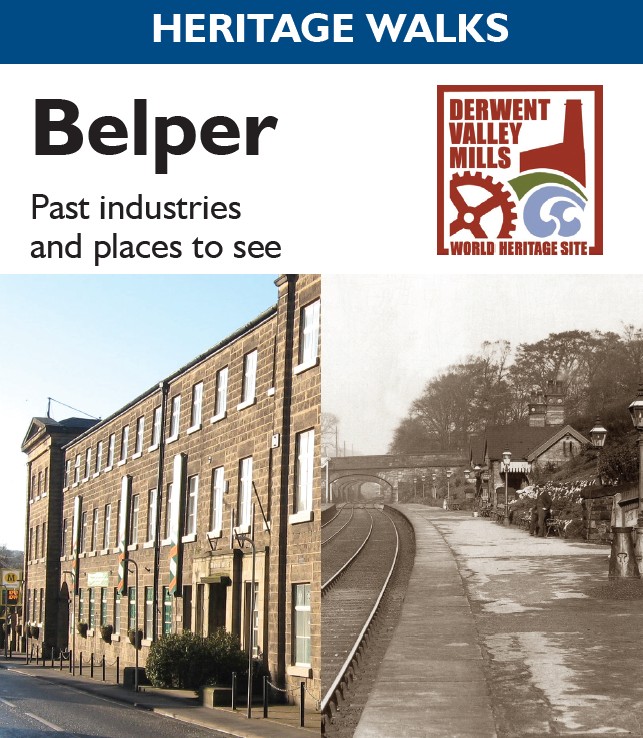
Belper Past Industries and places to see
The walk route is outlined below or can be downloaded as a pdf.
Heritage Walk 2
Past Industries and Places to See
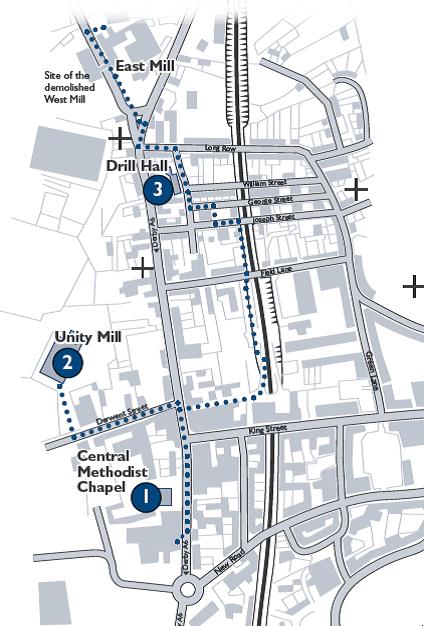
Belper has a strong industrial past, with cotton spinning, hosiery production, nail-making and the iron foundries providing thousands of jobs for many years. This walk begins at De Bradelei Mill, once the HQ of George Brettle and Co, one of the most renowned manufacturers of hosiery and other cotton goods. On this site, stockings were produced for George III and his grand-daughter Queen Victoria, and the cotton vest worn by Admiral Horatio Nelson at the Battle of Trafalgar in 1805. The interpretation board under the arches leading to the car park will tell you more about the company.
Walk through the large arch on to the main road – this is the A6, which follows the line of the turnpike road provided between Derby and Manchester in 1816-18. From the archway, look right and you will see the large gritstone warehouse of 1850 on the far side of the roundabout. This belonged to Wards, another major hosiery company.
Turn left, walking along the A6 towards the town centre. Next to De Bradelei Mill is the Central Methodist Chapel of 1807.
Continue along the road, then turn left down a channel just before the crossing. The large building in front of you is now the library but was part of a Thorntons factory. The toffee manufacturer came to Belper in 1947. Before then it was a hosiery factory. The library was once a music hall, where Gracie Fields performed. Turn left at the far end of the library and you’ll see more of the old factory frontage. Opposite it is the entrance to Unity Mill. Walk through to see the 1839 corn mill built by James Webster and enlarged by John Strutt from 1853. It was later converted to cotton spinning, then furniture production but is now an antiques centre.
Return up Derwent Street to Bridge Street (the A6), cross the road and walk under the arch by the Frearson’s shop into Wellington Court. On the left is Wellington House where Will Hay, star of Ealing film comedies, stayed as he began his career in Belper. At the end of the stone terrace follow the road ahead past the supermarket to the railway station of 1878. From the first platform you can see the recesses which once held the station buildings, and beyond these, looking north, the five road bridges which cross the stone-lined cutting designed by George Stephenson.
Walk up the steps from the platform and follow the footpath which runs parallel to the platform, until you come out on Field Lane. Cross the road onto another path running parallel to the railway cutting. This is The Ropewalk, so called because it runs at right-angles to a former ropewalk used for rope-plaiting.
At the end of the ropewalk we are in Joseph Street – part of the industrial housing built by the Strutts. Note the Telford/Macadam type road surfacing to the right of you.
Turn left and walk down the road until you reach No 3 Clusters Court – opposite is a channel to George Street. Walk along it. As you pass through the channel note the old workshop on your left, now converted into a house. Although the Strutts primarily only wanted women and children in the mills, they provided workplaces like these for men so whole families would settle in the town.
At end of the channel turn left, past some of the Strutts’ cluster houses (semi-detached and back-to-back), then at the bottom of the road turn right. You are now in Cluster Road. On the Drill Hall of 1902 on the left is a painted bell and arrow – to help people find and ring the church bells in case of a wartime invasion. Piggy Hill, the channel just past the drill hall, running down to the main road, was used from 1896 by butcher Edward Ryde to her in his fresh stocks of pigs.
At the end of Cluster Road turn left onto Long Row. On the right as you walk down to the A6 is Long Row School, provided by the Strutts for the community in 1818. In front of you, across the road is Christ Church of 1850. Bear right and cross the road at the crossing. You are now in The Triangle, where there is an interpretation panel on the mills. On the left is Pyms, a solicitor’s office once used for the mill armoury. Cross the road again, this time towards the big red mill, the East Mill of 1912. Turn left and under the bridge linking the buildings on opposite sides of the road. This is the Gangway of 1795. Turn right into the next car park. Here you will find more information at the Strutt’s North Mill museum.
To return to De Bradelei Mill simply return to The Triangle, turn right and follow the A6 road.


